
Crawl Space Vapor Barrier in Campbell, CA
A crawl space vapor barrier is a heavy-duty polyethylene sheet – typically 12 to 20 mil thick – installed across the crawl space floor and up the foundation walls to block ground moisture before it enters the building envelope. Most Campbell homes with a vented crawl space need one because Santa Clara Valley’s groundwater table and the region’s wet winters push soil moisture upward year-round, and that moisture has nowhere to go except into your floor assembly, framing, and air supply. Installing a vapor barrier correctly stops that cycle at the source.
At Topside Attic Insulation Campbell, we treat vapor barrier installation as a precision envelope job, not a plastic-sheeting errand. Before any material goes down, we document what’s already there – moisture readings, existing insulation condition, foundation vent locations, any signs of pest activity or standing water – and you receive a written scope and written price before anyone touches a tool. That’s Haven Standard Clause 1, and it’s how every job here starts. If you’d like to understand how vapor barrier fits within the broader crawl space solution, see our full Crawl Space Encapsulation & Vapor Barrier in Campbell page. To talk through what your crawl space needs specifically, call us at (831) 534-3206 – a live person answers, not a voicemail.
When You Need a Crawl Space Vapor Barrier
Crawl spaces in Campbell vary more than you’d expect. Homes in the Orchard City neighborhoods built before 1980 often have bare dirt floors and minimal venting. Newer construction in the Campbell Park area can still develop moisture problems if the original vapor retarder was torn during plumbing or pest work. Below are the conditions that tell us a vapor barrier is either missing or has failed.
- Musty odor in the living space, especially in winter. When soil moisture evaporates into the crawl space air and rises through subfloor gaps, mold spores and that distinctive damp smell travel with it. We see this regularly in Campbell homes after November rains when the water table rises under the older lots near Los Gatos Creek.
- Wood floors that feel soft, springy, or have begun to cup. Cupping – where floor board edges rise higher than the center – is a moisture-gradient problem. The underside of the flooring is absorbing humidity that a vapor barrier would have intercepted at the soil level.
- Condensation on ducts, pipes, or the underside of the subfloor. If you can see moisture beading on HVAC flex duct or copper supply lines in the crawl space, relative humidity down there is running high enough that the vapor barrier below has either degraded or was never installed to full coverage.
- Existing plastic that is torn, bunched, or covers less than 70% of the floor area. Builder-grade 6-mil sheeting laid loosely on the dirt degrades within a few years and provides inconsistent coverage. A failed or partial barrier is almost worse than none because it gives a false sense of protection while moisture migrates through the gaps.
- Rising energy bills alongside floor temperature complaints. Ground moisture evaporating into the crawl space lowers the effective R-value of any insulation installed between the joists. If your floor insulation is batts, they absorb moisture and lose roughly half their rated performance when wet. A vapor barrier keeps that insulation dry so it can do the job it was rated for.
- Recent pest or rodent activity in the crawl space. Rodent remediation almost always involves tearing out existing vapor barrier material. After that work is done and the space is cleared and cleaned, reinstalling a proper vapor barrier is a required step – not optional – to restore the moisture control the remediation disrupted. We pair this routinely with our attic cleaning and rodent proofing scope when the infestation ran the full building envelope.
Our Crawl Space Vapor Barrier Process
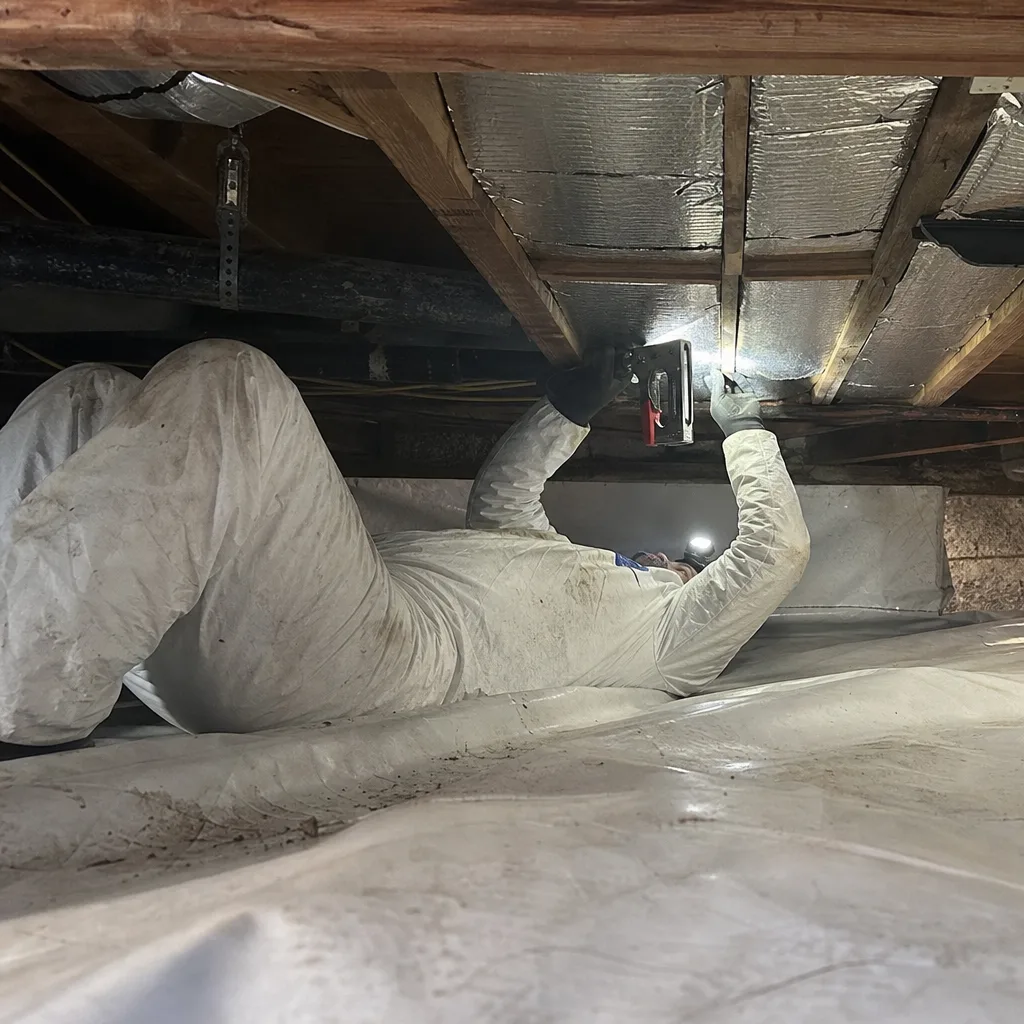
The install sequence matters as much as the material. Putting a high-quality barrier over standing water or unaddressed pest damage accomplishes nothing. Here is exactly how we approach every Crawl Space Encapsulation & Vapor Barrier job in Campbell.
- Pre-work inspection and moisture mapping. A technician enters the crawl space with a pin-type moisture meter and a calibrated humidity logger. We take readings at multiple points across the floor – corner to corner, near foundation vents, under bathrooms and kitchens – and photograph every measurement location. You receive those baseline numbers in your Documented Photo Record before any material is ordered. If we find standing water or active drainage issues, we tell you that on the spot with documentation; we do not install over a problem that will void the vapor barrier’s purpose within a season.
- Removal and disposal of failed existing material. Old 6-mil sheeting, degraded fiberglass batts lying on the dirt, rodent debris, and any loose insulation that has fallen from the joist bays all come out. This is not something we skip to save time. Layering new material over deteriorated product traps the odors and spores you were trying to get rid of.
- Foundation wall and pier preparation. Before the barrier goes down, we clean the perimeter to the footing and clear any debris from piers or posts. This matters because a vapor barrier that terminates at the dirt-wall junction – rather than running up the foundation wall and mechanically fastening to it – allows soil moisture to wick up the wall face and bypass the barrier entirely.
- Barrier installation: floor and walls as one continuous system. We use heavy-gauge polyethylene – 12 mil minimum on standard jobs, 20 mil on full encapsulation scopes – lapped a minimum of 12 inches at all seams and sealed with vapor barrier tape rated for the specific material weight. The barrier runs up the foundation walls to the sill plate or first course of block, where it is mechanically fastened. Every penetration – pipes, posts, columns – is cut around, wrapped, and taped. No gaps, no shortcuts at the hard-to-reach back corners.
- Mechanical fastening and vent treatment. Clips or concrete fasteners anchor the wall section to the foundation every 18 to 24 inches. If the scope includes vented crawl space conditioning, we address vent baffles at this stage so the installed barrier is not compromised by the first wind event. On encapsulation jobs, we coordinate vent sealing to match Santa Clara County building code requirements for conditioned crawl spaces.
- Post-installation documentation. We take a full second pass through the crawl space with the same moisture meter and camera we used at the start – photographing completed seams, fastening points, penetration wraps, and wall terminations. You receive a Documented Photo Record showing both the before and after state of the entire crawl space. On jobs where spray foam or batt insulation is also going into the joist bays, we do not add that layer until the barrier inspection photos are complete.
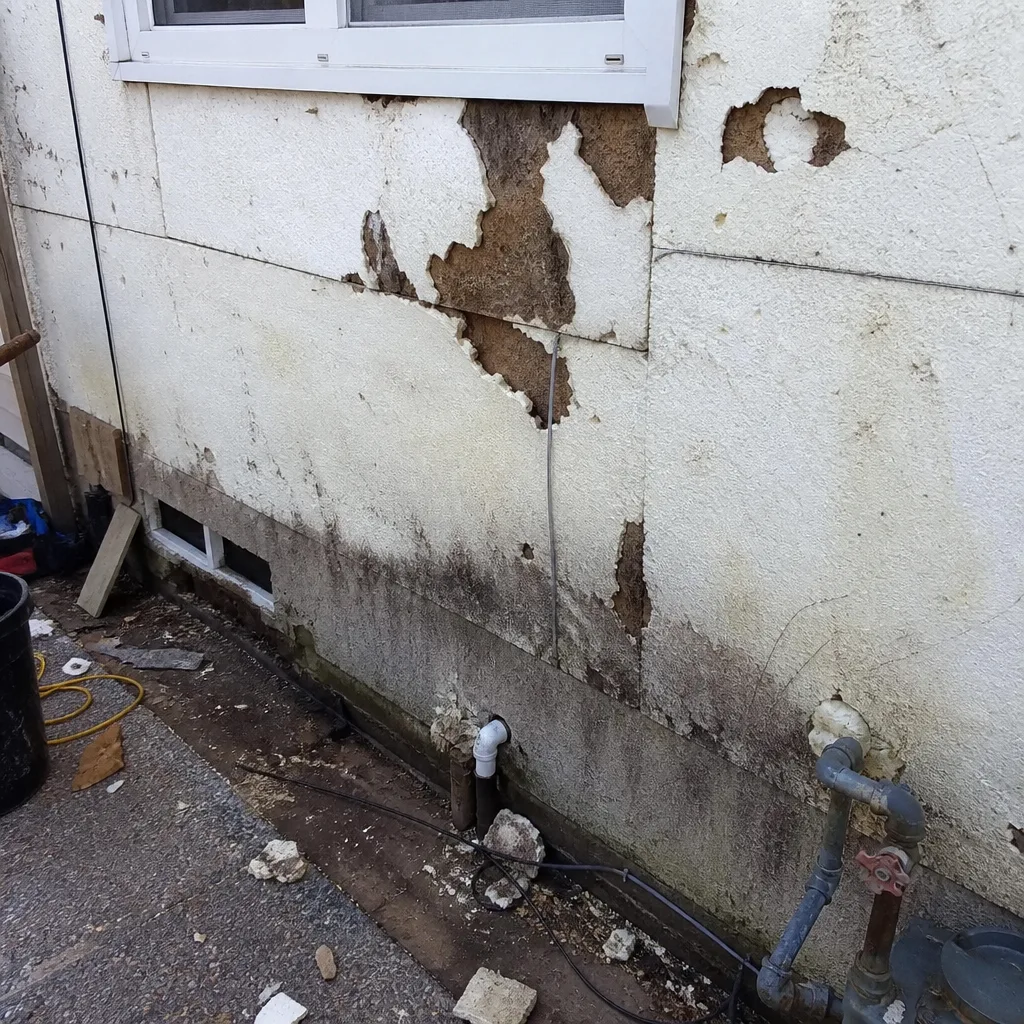 Before
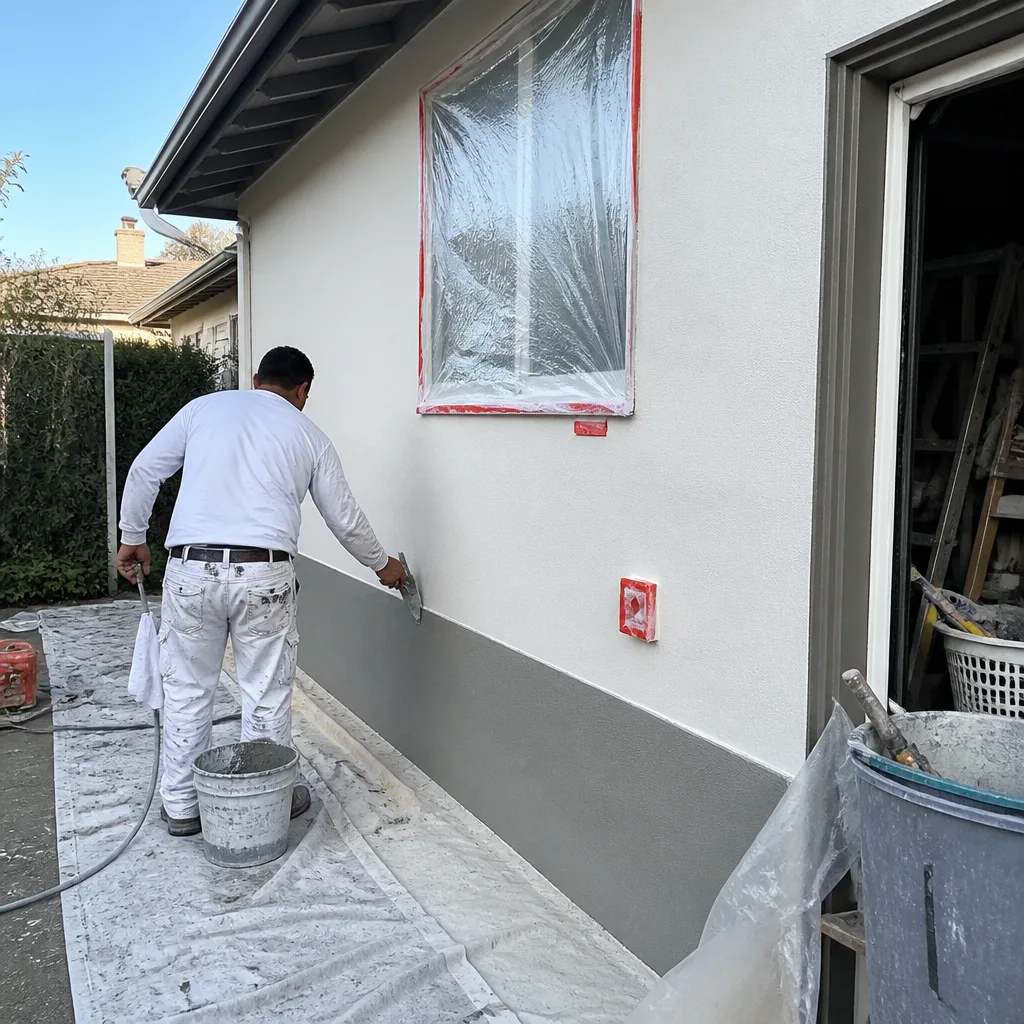 After
AfterCrawl Space Vapor Barrier Pricing in Campbell
Vapor barrier installation in Campbell typically runs between $1,200 and $3,800 for most single-family homes, depending on crawl space square footage, access difficulty, current condition, and the barrier specification. Below are the factors that move the number in either direction.
| Cost Factor | Lower End | Higher End |
|---|---|---|
| Crawl space square footage | Under 800 sq ft | 1,500+ sq ft |
| Barrier specification | 12-mil poly (vented crawl space) | 20-mil reinforced (encapsulation) |
| Access and clearance | Standard 18-in clearance, single hatch | Under 14 inches, multiple obstacles |
| Removal of existing material | Minimal – no prior barrier in place | Heavy debris, failed batts, pest damage |
| Foundation wall coverage | Floor only | Floor plus full wall run to sill plate |
A few Campbell-specific notes: homes on the west side of the city near the creek floodplain sometimes require heavier-gauge material or supplemental drainage mat under the barrier because seasonal groundwater pressure is higher than average. Homes in older downtown Campbell neighborhoods with partial concrete and partial dirt floors get a higher labor estimate because mixed-surface prep takes longer and penetrations are typically more numerous.
Under Haven Standard Clause 1, you receive a flat written price and written scope before any work starts. No estimates are revised upward once you’ve signed off unless we encounter a structural condition inside the crawl space that neither party could see from the access hatch – and if that happens, we document it and present the revised scope in writing before continuing. There are no surprises billed after the fact.
We also offer a free second opinion on any written estimate you’ve already received from another contractor. Bring it to us and we’ll go through it line by line with you – materials, mil rating, seam-sealing method, wall termination detail – so you know exactly what you’re comparing.
To get a written price on your specific crawl space, call (831) 534-3206. A live person answers.
FAQs – Crawl Space Vapor Barrier
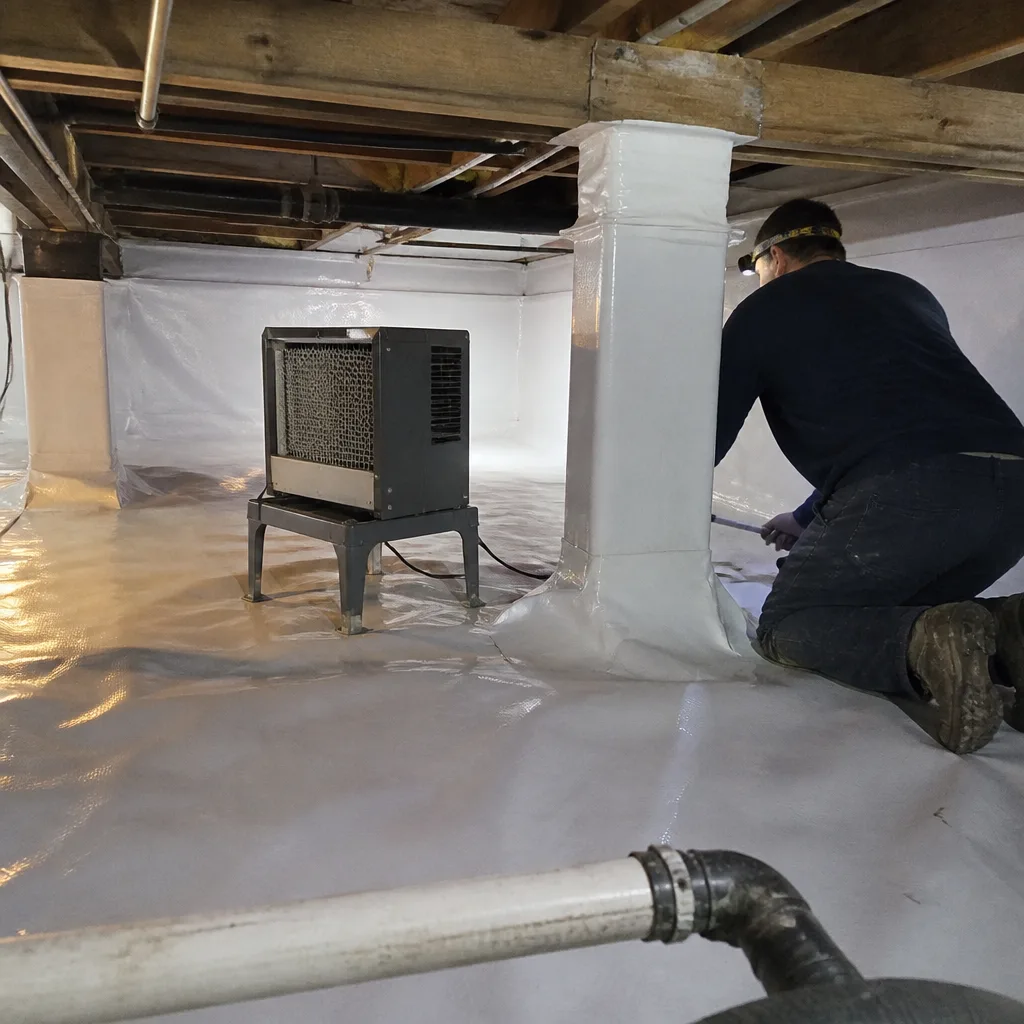
How thick should a crawl space vapor barrier be?
For a vented crawl space in Campbell, 12-mil polyethylene is the practical minimum for durable performance. The builder-grade 6-mil sheeting you’ll find in many older homes here tears easily during any future crawl space access, degrades faster against the alkaline soil conditions common in the Santa Clara Valley, and loses its flat-seal contact with the dirt within a few years. If you’re moving toward a fully conditioned crawl space with Crawl Space Insulation – vents sealed, walls insulated – 20-mil reinforced barrier is the appropriate spec because it needs to function as a long-term air and moisture boundary, not just a temporary ground cover. We recommend based on what your crawl space conditions and intended scope require, not on which product has the higher margin. Call (831) 534-3206 for a written price once we’ve looked at your specific conditions.
Can I install a crawl space vapor barrier myself?
The physical work of unrolling polyethylene is not technically complex, but the details that make a vapor barrier actually perform – continuous seam laps of at least 12 inches, mechanically fastened wall termination, properly sealed penetrations, and pre-installation moisture mapping to confirm you’re not trapping an existing problem – are where DIY installs typically fall short. A barrier installed with gaps at the foundation wall or unsealed pipe penetrations still allows significant moisture migration; you just won’t see where it’s coming from. We document baseline moisture readings before the install and post-install readings after, so you have confirmation that the barrier is functioning, not just installed. That documented record is part of every job we do in Campbell.
How long does a crawl space vapor barrier last?
A properly installed 12-mil barrier in a vented crawl space, left undisturbed, typically performs for 15 to 25 years. A 20-mil reinforced barrier in a fully conditioned crawl space can last 30 years or more. The life-shortening factors we see most often in Campbell are: foot traffic from HVAC or plumbing service that punches holes without patching, rodent activity that shreds the material (we see this regularly in homes along the Hacienda and Westside neighborhoods where roof rats are active year-round), and original installation that was never properly taped at seams or mechanically anchored at the walls – so the first wet season lifts and bunches the barrier. Annual visual checks during any other crawl space service visit catch damage early.
What’s the difference between a vapor barrier and full encapsulation?
A vapor barrier installed on the crawl space floor – and up the foundation walls – controls ground moisture. Full crawl space encapsulation goes further: it adds insulation to the foundation walls, seals the foundation vents to make the crawl space a conditioned space rather than an outdoor air zone, and sometimes includes a dehumidifier if the relative humidity targets can’t be met passively. Most Campbell homes with persistent moisture problems benefit from encapsulation rather than barrier-only installation because a vented crawl space in a wet winter pulls humid outside air in through those vents regardless of how good the floor barrier is. The right answer depends on your specific conditions – our inspection will tell you which scope addresses your actual problem. See our full Crawl Space Encapsulation & Vapor Barrier in Campbell page for how those two scopes compare side by side.
Why Campbell Homeowners Choose Topside Attic Insulation Campbell
Envelope Insulation Co. has operated under The Haven Standard since 2016, and in that time the crew has completed work in more than 9,000 homes – every one with a written price before the job started and a documented photo record when the crew left. That number is not marketing copy; it’s the record that produces the kind of pattern recognition that matters in crawl space work: knowing which Campbell neighborhoods have chronic groundwater issues, which foundation types are prone to moisture wicking at the sill, and which pest remediation contractors tend to leave barrier material in the worst condition.
Wes Okafor runs every job under a single standard: document what you find, price it in writing before touching anything, and prove the result when you leave. The 365-Day Done Right Promise backs all completed work. If something isn’t right within that window, we make it right – in writing, not over a phone argument.
Background-checked, uniformed technicians handle every install. Calls to (831) 534-3206 reach a live person around the clock – not an answering service that delivers messages the next business day.
For homeowners who want to understand the full building envelope picture before making any decisions, our home page outlines the complete service line. Crawl space vapor barrier is one part of a connected system – floor insulation, subfloor air sealing, and attic performance all interact with what happens below the house, and we can assess the full envelope in a single documented visit if that’s useful.
If you have a competing written estimate already in hand, bring it. We’ll read it with you and explain what the line items mean in practice – mil ratings, seam method, wall termination detail – so you’re comparing actual scope, not just bottom-line numbers.
To schedule an inspection and receive a written price for crawl space vapor barrier installation in Campbell, call (831) 534-3206. A live person answers, and your written estimate costs you nothing.
Written by Wes Okafor, Owner at Topside Attic Insulation Campbell, serving Campbell.